Foundations
$29one-time · Modules 1-2
A low-risk way to start: the state-vs-action gap and the scoring-policy design that the rest of the course builds on.
From the state-vs-action gap to PPO, GRPO, and DPO, then a runnable car-navigation capstone where you train real policies and measure what is actually true. Built on the agi-eval package, so every claim is one you can check.
A low-risk way to start: the state-vs-action gap and the scoring-policy design that the rest of the course builds on.
Everything: foundations, the full RL formalism, the algorithms that train agents (PPO, GRPO, DPO), and the runnable car-navigation capstone.
Every lesson is free to read right now. Sign-in, progress tracking, and certificates light up as the course goes live; Lesson 1A always stays a free preview.
The state-space vs action-space gap, what it costs, and the math that turns implicit decisions into measurable ones.
Derive value-aligned scoring from user values, then the two-stage score-then-generate architecture. With a runnable agent.
MDPs and observability, action spaces, stochastic rewards and risk (CVaR), trajectory alignment, preference learning, and curricula.
MC/TD foundations, value-based deep RL, policy gradients into PPO and GRPO, DPO and the direct-alignment family, reflective agents.
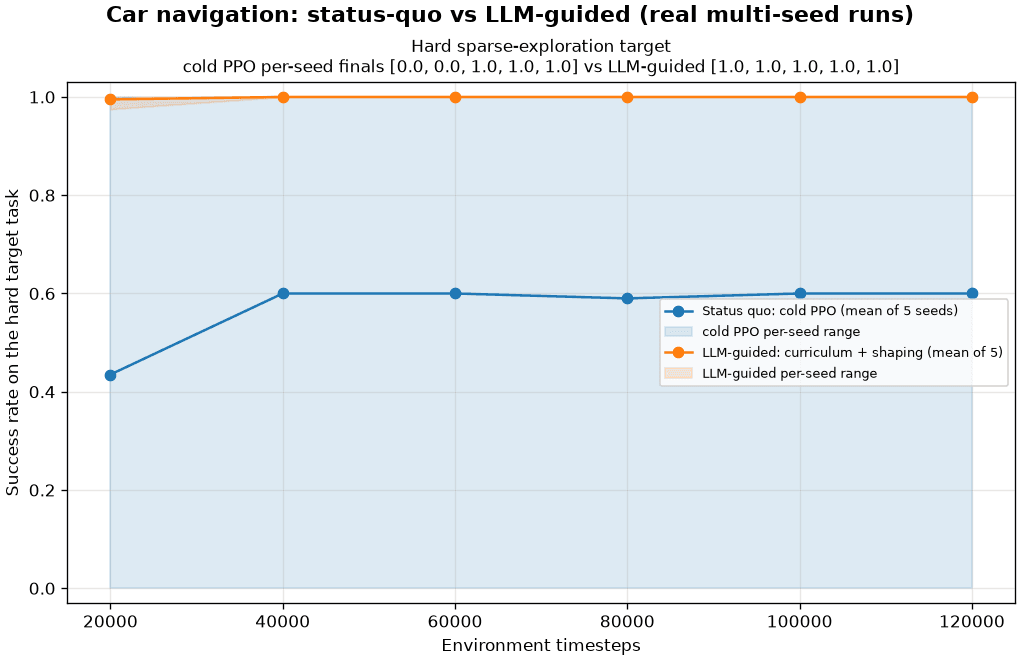
Train a status-quo PPO baseline and an LLM-guided agent on the same sparse-reward task, across five seeds, and report the real numbers.
The honest finding: on easy tasks the LLM guidance did not converge faster. The payoff was reliability on hard sparse tasks: cold-start solved 3/5 seeds, guided solved 5/5. No synthetic plots, the figure is the run.
Read the capstone ›